
Tips On Lunging: Part 1
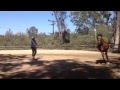
Hi this is Will Faerber from Art2Ride and I am here with Dave Murphy and he is lunging his horse Zoe. We have had quite a few questions come in on the internet asking about lunging and how to start their horses, so I thought this would be a good opportunity. You can watch Dave who is still learning himself and we can talk about what he is doing right and what he is doing wrong.
As I have stated before in some of my answers to some of you, the most important thing you have to establish when you are lunging a horse is the horse staying out at the end of the line. Don’t worry about if the horse is trotting or walking and especially whoa. Most people worry about whoa, when in fact you need to worry about go. The horse needs to go out to the end of the line using the whip as your leg essentially. You are basically moving the horse into your hand, which is your rein. If this is done correctly the horse will move out and stay out there. The next important thing once you can keep the horse out there, is you can begin to worry about what gait the horse is in and the quality of that gait. But the first thing that has to happen as I said, is the horse has to stay out there.
As you can see in the video, Dave has let Zoe become too slow so he needs to keep his whip up and send her on forward so she will go out into the rein a little more. He has to be a little more active, notice how he is always walking forward with the horse and never backing up, which was a problem that he had when I first started working with him, he was always backing away from the horse. Body language is so important! It is so important that you stretch up and stand tall when lunging because that will help the horse respect you. Once again there is a visual aspect, the horse must respect your position on the ground. Zoe gets a little too slow again, can you see how she started to come in on the line? So once again, he needs to send the horse out on the line and keep her more active. Then Dave must begin to look for a working trot, that is when the horse is reaching deeply underneath the body.
Now this is a horse that is quite nervous so she goes into a little tizzy fit there because a car drove by. A few months ago, that little fit would have lasted a half an hour or so with her running around like a lunatic, now he is able to bring her right back down by sending her forward. So the most important thing to remember, just like when you ride, you can’t constantly stop and let the horse look at everything that it wants to look at. If you do that, you will never get from point A to point B because pretty soon they will want to look at everything and you will get nowhere at all. So the best advice in the classical school is to ignore whatever it is that is making them nervous and just send them on forward. Just send them on actively forward, even if it’s too actively forward you can just settle them down after the fact, just don’t try to whoa! That’s the biggest mistake that people make with horses, especially hot blooded horses, is they worry about if the animal will stand still before they can actually channel the horse forward.
So you kind of have to think how a stallion works a herd, watch what a stallion does (you can probably find some videos on youtube), he controls the herd by pushing it forward, just like we are controlling this mare by sending her forward on the lunge line. A stallion never stops a horse, in fact he has to woo the lady to get her to stand still and that’s only after he has had her moving around a while. So if you watch a stallion move a herd, it is exactly how you must lunge a horse. The stallion will get right behind them and nip them right in that fleshy part of their buttocks above the hocks, which is the place that you ought to touch the horse with the whip. There are only three places that we ever want to touch the horse with the whip: the fleshy place above the hock, right at the point where your leg would be and want the horse to move away, and the third place that is okay to use the whip on if the horse spins around on you is the shoulder because it get them to switch back around to the other direction.
So now we see that Dave has Zoe moving better, she has a nice swinging trot now and she is relaxing over her topline though she tends to go up and down. This is a horse who’s mouth was very nervous and busy, so we spent quite a bit of time just letting her relax. Notice how the side reins are correctly adjusted on this horse, they are at such a length that the horse is not confined in any way but if she were to throw her head way up in the air it’s going to encounter the contact with the bridle. If she stretches down there is something there for her to stretch down into and accept that contact. So that is the correct length of side reins, unless you are working a much more advanced horse into collection, and that’s a whole new lesson. For right now, most of you and even advanced level horses they need to mostly lunge in this length of rein. The idea of lunging is getting them soft and round over the back and stretching into the contact instead of confining their necks as most people are doing today in riding. You see all these horses with their necks crimped in and that’s not the same thing as collection. After the horse has developed the back, collection is the degree to which the horse lowers the three joints of the hind leg. It’s very simply one thing, it’s not a horse that is actively snapping it’s legs up either as we see in the show ring today. Those horses are just active, they are not really collected.
So happily, we see Dave on his way to some good and active work there now, she is starting to swing into the contact and she is starting to relax even though there are cars going by. He is keeping her working. She spooks a little bit, same thing here, he is not going to try and stop her, he is going to send her on a little bit with his whip and then he is going to settle her down. Instead of making her whoa first, he is going to make her go a little bit. My father taught me at a very young age that if I had a horse that was a runaway, he would say to take it out into a field and gallop it until it doesn’t want to gallop anymore and then ride it for a few minutes and it won’t runaway anymore. That is the most important lesson you will ever learn with horses, if you try to force them to stand still you will be in trouble.
Remember our primary goal that has to happen before anything else before the pieces will all work is the horse needs to stay out on the lunge line into the hand so that we can control it. Just like when we ride, we want the horse to move into the contact with the bridle not fall behind it nor bear down on it. We want it to respect it yet take soft and supple contact with it that allows us to communicate with the horse. Very nice, this is Dave Murphy lunging Zoe today. I hope some of these points have helped you by watching Dave lunge. You can see the proper development of the horse now, she is starting to stretch into the contact though she could be a little more active there and once we get everything else we have to be sure that we get the working trot. The working trot is the horse working over the topline with a good swinging trot, that is the deepest step underneath with the slowest rhythm. Those are the things we are trying to put together. When we put those things together we usually have the working trot, that is the horse working over it’s back. See how nicely she is starting to stretch into that contact now?
Thanks a lot, this is Will Faerber from Art2Ride and we will see you next time!

7 responses to “Tips On Lunging: Part 1”
Leave a Reply

Thank you for being here in cyber space =)……… for folks like me to come watch , observe in the privacy of our homes….I use CD in working with my gaited tennessee walking horses….I KNOW I ride a HALLOW Horse ….but I am working on keeping them round or rounder while at home and on the trail….show ring stuff is done once in awhile….my husband and I are fighting profusely against the torturous things done to our breed…. With what the media has broadcasted on the padded & chained TWH we can ONLY HOPE that people on the OUTSIDE (our breed) will also speak up and let their Congressmen know ..This will not be tolerated any longer. Take the Pads and Chains Away from the TWH industry NOW!
YOUR a Breath of Fresh Air for me….I came across your site through Sylvia Loch face book CRC. She also knows of the struggle our Breed is going through.
If you have a moment in your busy day to take a look at my website … you can see what we are up against.
I will send my other gaited friends here who are interested in CD.
Thank You for being “About the Horse” in all arenas.
 Melanie says:
 Hi all you good people of art2ride!
Thank you for the fantastic content you so generously share.
I have a question regarding lunging and moving the horse out to the end of the line. You mention using the whip as your leg to yield the horse away from you. Are you able to break it down further? How do we best teach the horse to move away from the leg without running off; how do we teach the horse to distinguish the “forward” command with the whip and the “sideways” command? By working it in hand? If so, would you do work in hand with a young horse starting it off, before lunging it?
-
Kali says:
No, it is a mistake to start work in hand before you have gotten the horse quiet on the lunge and under saddle as the young horse can become very confused and become difficult to mount as it thinks you want it to move away every time you approach the side of the horse. When lunging the first thing you work on is that the horse will move out to the end of the line away from a tap with the lunge, even if that means the horse runs a little because you can’t control anything else until the horse will move away from you. It is the most basic aspect of submission and the foundation of training. Watch horses in pasture and notice how the lead horse will control the herd by coming along and nipping at the hind quarters of another horse that it wants to move. That’s exactly what you are doing when you lunge.
 Karen says:
 I own a 24 year old arabian-cross stallion. He was broken in at the age of 2, causing him to have a very weak back. He came to me at the age of 8 , after which retraining started. He reached Prix St. Georges level (out of competition at about 13/14 and I kept on working him until he was about 16. For me, this was my very first horse that I trained up to this level. I made mistakes along the way, but in the end, he became a horse with a very well confirmed topline and a strong back.
At the age of 16, I handed him over to a young, inexperienced rider as a schooling horse. She learned a lot, but the horse suffered. He was diagnosed with (slight) KS three years later. I tried to help her, riding him again and he became somewhat better, but in the end it wasn’t great for him. I decided to retire him at the age of 21, only to pick up training again a year later, because his back was dropping so much from doing nothing. When he uses his back properly, he has no KS, but any drop causes the spine the touch.
The last two years have been difficult. Twice, he lost a giant amount of weight. The first time due to a move into a pasture with harsh conditions (he can’t stand cold/rain). He regained the weight and I started training again on the lunge. Last november, when he had just begun regaining muscles, he suddenly had an abces in his hind leg and lost all the weight (and muscles) again. I moved him back into his old pasture, with less horses and more shelter.
At the moment he is starting to look ok again. His leg healed, but he has no muscles at all. Despite his age, I would like to start him again. He needs the muscles to keep his back up.
So my question: how would you start an old horse again after this kind of injury and weight loss has eaten away all of his muscles? His leg has healed up properly, and the vet has cleared him healthwise.
Most people tell me to just retire him, because he is old, but I think that might just finish him off. I have no desire to ride him, but he needs to build up those muscles and topline. His KS is worsening every day his back is dropped like this. How would you retrain a horse like this?
-
I would lunge him, taking plenty of time to let him develop without over stressing him, lots of correct walk work.
 Tony says:
 Hi
We recently purchased a four year old Thoroughbred mare. There is a trainer on site that has been teaching my daughter how to train her. She has been successful thus far at keeping her out on the end of the lunge line. The problem is that she wants to run into the canter. When she does this, the trainer wants my daughter to snap the reign and tell her no. If that’s unsuccessful, she tells her to do it harder.
I don’t know anything about training a horse so I can’t tell my daughter if what she is being told is right or wrong. She has no problem being firm with a horse, but she worries about this being overly so.
I want to be able to put her mind at ease either way.
-
Answered by Art2Ride Associate Trainers:
I would recommend to tell your daughter that, when the horse starts to run off on her on the lungeline, to stand still in the middle of the circle and turn slowly with the horse. Make the circle smaller (for the horse) by shorten your rein. And use your voice in a relax way.
Good luck!
Thank you for being here in cyber space =)……… for folks like me to come watch , observe in the privacy of our homes….I use CD in working with my gaited tennessee walking horses….I KNOW I ride a HALLOW Horse ….but I am working on keeping them round or rounder while at home and on the trail….show ring stuff is done once in awhile….my husband and I are fighting profusely against the torturous things done to our breed…. With what the media has broadcasted on the padded & chained TWH we can ONLY HOPE that people on the OUTSIDE (our breed) will also speak up and let their Congressmen know ..This will not be tolerated any longer. Take the Pads and Chains Away from the TWH industry NOW!
YOUR a Breath of Fresh Air for me….I came across your site through Sylvia Loch face book CRC. She also knows of the struggle our Breed is going through.
If you have a moment in your busy day to take a look at my website … you can see what we are up against.
I will send my other gaited friends here who are interested in CD.
Thank You for being “About the Horse” in all arenas.
Hi all you good people of art2ride!
Thank you for the fantastic content you so generously share.
I have a question regarding lunging and moving the horse out to the end of the line. You mention using the whip as your leg to yield the horse away from you. Are you able to break it down further? How do we best teach the horse to move away from the leg without running off; how do we teach the horse to distinguish the “forward” command with the whip and the “sideways” command? By working it in hand? If so, would you do work in hand with a young horse starting it off, before lunging it?
No, it is a mistake to start work in hand before you have gotten the horse quiet on the lunge and under saddle as the young horse can become very confused and become difficult to mount as it thinks you want it to move away every time you approach the side of the horse. When lunging the first thing you work on is that the horse will move out to the end of the line away from a tap with the lunge, even if that means the horse runs a little because you can’t control anything else until the horse will move away from you. It is the most basic aspect of submission and the foundation of training. Watch horses in pasture and notice how the lead horse will control the herd by coming along and nipping at the hind quarters of another horse that it wants to move. That’s exactly what you are doing when you lunge.
I own a 24 year old arabian-cross stallion. He was broken in at the age of 2, causing him to have a very weak back. He came to me at the age of 8 , after which retraining started. He reached Prix St. Georges level (out of competition at about 13/14 and I kept on working him until he was about 16. For me, this was my very first horse that I trained up to this level. I made mistakes along the way, but in the end, he became a horse with a very well confirmed topline and a strong back.
At the age of 16, I handed him over to a young, inexperienced rider as a schooling horse. She learned a lot, but the horse suffered. He was diagnosed with (slight) KS three years later. I tried to help her, riding him again and he became somewhat better, but in the end it wasn’t great for him. I decided to retire him at the age of 21, only to pick up training again a year later, because his back was dropping so much from doing nothing. When he uses his back properly, he has no KS, but any drop causes the spine the touch.
The last two years have been difficult. Twice, he lost a giant amount of weight. The first time due to a move into a pasture with harsh conditions (he can’t stand cold/rain). He regained the weight and I started training again on the lunge. Last november, when he had just begun regaining muscles, he suddenly had an abces in his hind leg and lost all the weight (and muscles) again. I moved him back into his old pasture, with less horses and more shelter.
At the moment he is starting to look ok again. His leg healed, but he has no muscles at all. Despite his age, I would like to start him again. He needs the muscles to keep his back up.
So my question: how would you start an old horse again after this kind of injury and weight loss has eaten away all of his muscles? His leg has healed up properly, and the vet has cleared him healthwise.
Most people tell me to just retire him, because he is old, but I think that might just finish him off. I have no desire to ride him, but he needs to build up those muscles and topline. His KS is worsening every day his back is dropped like this. How would you retrain a horse like this?
I would lunge him, taking plenty of time to let him develop without over stressing him, lots of correct walk work.
Hi
We recently purchased a four year old Thoroughbred mare. There is a trainer on site that has been teaching my daughter how to train her. She has been successful thus far at keeping her out on the end of the lunge line. The problem is that she wants to run into the canter. When she does this, the trainer wants my daughter to snap the reign and tell her no. If that’s unsuccessful, she tells her to do it harder.
I don’t know anything about training a horse so I can’t tell my daughter if what she is being told is right or wrong. She has no problem being firm with a horse, but she worries about this being overly so.
I want to be able to put her mind at ease either way.
Answered by Art2Ride Associate Trainers:
I would recommend to tell your daughter that, when the horse starts to run off on her on the lungeline, to stand still in the middle of the circle and turn slowly with the horse. Make the circle smaller (for the horse) by shorten your rein. And use your voice in a relax way.
Good luck!